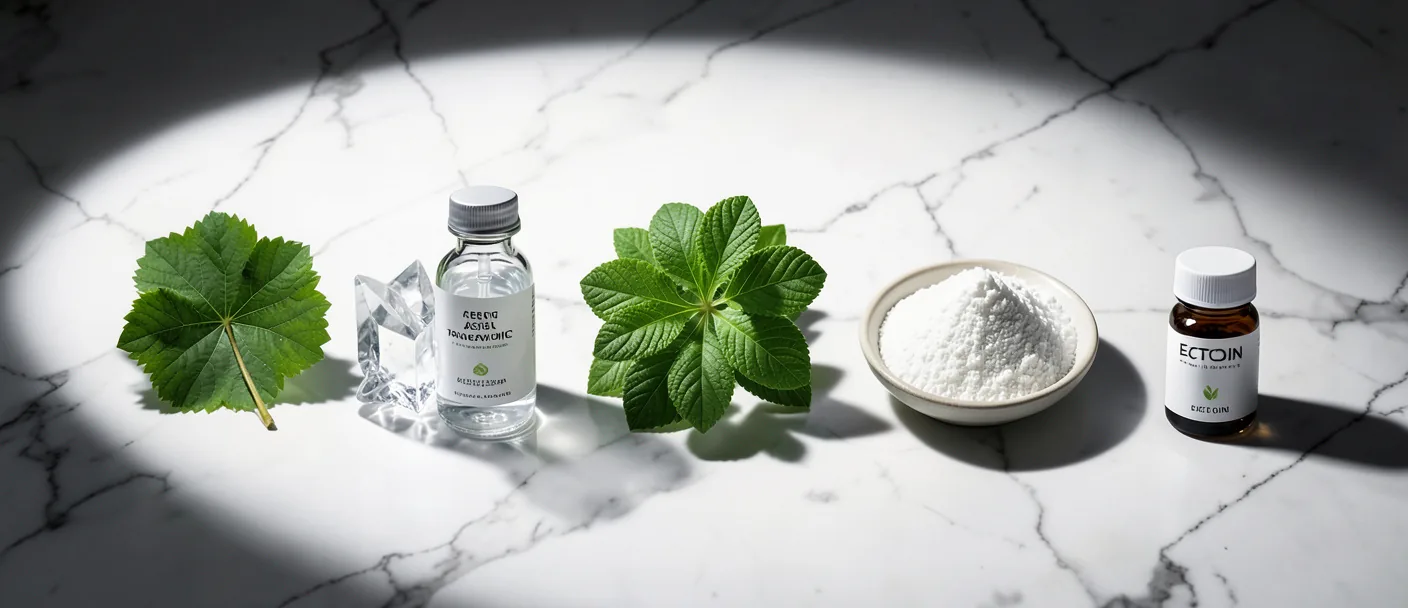
Marketing gives you a name and a claim. Science gives you a mechanism, a concentration range, and an honest assessment of the evidence. These deep dives cover everything I know — as a cosmetic chemist — about five actives that genuinely deserve the attention they receive.
The retinol alternative
Evidence Rating
Multiple RCTs vs retinol; evidence base growing rapidly
Bakuchiol is a meroterpene phenol extracted from the seeds of Psoralea corylifolia, a plant used in Ayurvedic and traditional Chinese medicine for centuries. In cosmetic science, it gained attention when researchers discovered it upregulates the same retinoid signalling pathways as retinol — despite having a completely different molecular structure. This functional mimicry without structural similarity is what makes bakuchiol genuinely scientifically interesting, not just a marketing hook.
Bakuchiol activates retinoid receptors (RAR-alpha, RAR-beta, RAR-gamma) and upregulates retinoid-responsive genes including those controlling collagen synthesis (COL1A1, COL1A2), elastin production, and keratinocyte turnover. Crucially, it also upregulates the retinoic acid metabolising enzyme CYP26 — the same enzyme induced by tretinoin — confirming genuine retinoid pathway engagement.
Unlike retinol, bakuchiol does not require enzymatic conversion to its active form — it is active as applied. It also shows anti-inflammatory activity via NF-kB inhibition and antioxidant properties via free radical scavenging, giving it a broader activity profile than retinol's relatively narrow retinoid-pathway focus.
The landmark study by Dhaliwal et al. (2018, British Journal of Dermatology) — a double-blind, 12-week randomised controlled trial — compared 0.5% bakuchiol (twice daily) against 0.5% retinol (once daily) in participants with photodamaged skin. Both groups showed comparable improvements in wrinkle surface area, hyperpigmentation, skin firmness, and elasticity. The retinol group had significantly more skin irritation, dryness, and stinging. The bakuchiol group showed essentially no adverse reactions.
A 2020 in vitro study published in the International Journal of Cosmetic Science confirmed bakuchiol's collagen stimulation via dermal fibroblast activity at concentrations as low as 0.01%, providing mechanistic explanation for the clinical findings.
Chloé's assessment: Bakuchiol is the most evidence-backed "natural retinol alternative" by a significant margin. It's one of the few instances where the clean beauty claim (plant-derived, gentle, effective) is backed by genuine mechanistic science. Anyone who cannot tolerate retinol — whether due to sensitivity, rosacea, or pregnancy — should consider it seriously. It is not as potent as prescription tretinoin, but for OTC skincare it competes admirably.
The brightening workhorse
Evidence Rating
Multiple clinical trials in melasma; outperforms some Vitamin C data
Tranexamic acid (TXA) was originally developed as a pharmaceutical to prevent excessive blood clotting — it is used intravenously in surgical contexts. Its discovery as a skin brightening agent came from observational reports that patients receiving oral tranexamic acid for coagulation disorders also experienced fading of melasma lesions. This led to its investigation as a topical cosmetic active, where it has become one of the most evidence-supported brightening agents available without prescription.
Tranexamic acid works through multiple anti-pigmentation mechanisms simultaneously. Its primary pathway: it inhibits the plasminogen-plasmin system in keratinocytes. Plasmin normally activates arachidonic acid, which in turn stimulates melanocyte activity via prostaglandin E2 and alpha-MSH signalling. By blocking plasminogen activator interaction with keratinocytes, TXA reduces the UV-induced signal cascade that drives excess melanin production.
Additionally, TXA inhibits tyrosinase activity directly (the rate-limiting enzyme in melanin synthesis), competes with tyrosine for tyrosinase binding sites, and reduces dermal vascularity — the latter being relevant to the erythematous component of melasma that is often overlooked in purely pigmentation-focused treatments.
Vitamin C (L-ascorbic acid) is the best-known brightening ingredient in clean beauty. Tranexamic acid competes with it meaningfully. A direct comparison study by Ebrahimi and Naeini (2014) found that 3% tranexamic acid applied twice daily produced comparable brightening to 4% hydroquinone (the pharmaceutical standard) over 12 weeks, with far better tolerability. Vitamin C head-to-head data is more limited, but TXA's formulation stability advantage is significant — vitamin C is notoriously unstable, oxidising to dehydroascorbic acid and losing efficacy quickly. TXA is stable across a much wider range of conditions.
The two can be combined effectively: vitamin C acts as an antioxidant at the enzyme level (reducing dopaquinone back to DOPA), while TXA interrupts upstream signalling pathways. They are synergistic rather than redundant.
Chloé's assessment: Tranexamic acid is significantly underrated relative to its evidence quality. It outperforms most "natural" brightening alternatives (kojic acid, arbutin, licorice root) in head-to-head studies. Its only limitation in clean beauty contexts is its synthetic origin — but the evidence clearly justifies inclusion, and its tolerability profile makes it accessible to skin types that cannot use more irritating actives like high-concentration vitamin C or retinol.
The wound-healing botanical
Evidence Rating
Extensive wound healing RCTs; growing dermatology data
Centella asiatica — also known as gotu kola, tiger grass, or cica — is a tropical herbaceous plant with a multi-century history in wound treatment across Asian traditional medicine. In modern skincare, it has transitioned from a traditional remedy to one of the most scientifically investigated plant actives in cosmetics. The key distinction from many botanical ingredients: centella's active compounds have been individually isolated, characterised, and tested in controlled studies — not just evaluated as a crude plant extract.
The primary wound-healing component. Stimulates collagen synthesis in dermal fibroblasts via TGF-beta signalling. Shown to accelerate epidermal barrier repair in multiple controlled studies. Also demonstrates antioxidant activity and mild anti-inflammatory effects via prostaglandin inhibition.
The principal anti-inflammatory compound in centella. Strongly inhibits NF-kB pathway activation, reducing pro-inflammatory cytokine release (IL-1, TNF-alpha). Demonstrated in vitro and in clinical studies on atopic dermatitis, perioral dermatitis, and post-procedure skin repair. Madecassoside is the active component in La Roche-Posay Cicaplast, where it is used as an isolated pure compound rather than as a crude extract.
The aglycone forms of asiaticoside and madecassoside (without the sugar moiety). More lipid-soluble, potentially better dermal penetration. Asiatic acid has demonstrated fibroblast proliferation stimulation and anti-scar activity in keloid and hypertrophic scar models.
A 2012 study published in Phytomedicine found that a centella asiatica extract formulation significantly improved transepidermal water loss (TEWL), erythema, and scaling in atopic dermatitis patients over an 8-week double-blind trial. A 2020 Korean clinical study confirmed barrier repair benefits comparable to conventional corticosteroid-free barrier creams in mild eczema, with centella showing superior long-term tolerability.
The trend in K-beauty — which drove global consumer awareness of "cica" products — is backed by genuine science, which is not always the case with trendy ingredients.
Chloé's assessment: Centella asiatica is the rare case where a traditional botanical remedy has had its mechanisms thoroughly mapped by modern science. The distinction between crude extract and isolated active compounds matters enormously in practice — look for products that specify madecassoside or asiaticoside concentrations rather than simply "centella extract." The K-beauty trend got this one right.
Acne + rosacea dual mechanism
Evidence Rating
FDA-approved prescription use; extensive dermatology RCTs
Azelaic acid is a naturally occurring dicarboxylic acid found in grains including barley, wheat, and rye, and produced endogenously by Malassezia yeast on skin. Commercial azelaic acid is synthesised for purity and cost reasons, but its natural occurrence means it is broadly compatible with clean beauty formulation philosophies. At prescription concentrations (15–20%), it is FDA-approved for acne vulgaris and rosacea — making it one of the few cosmetic-grade actives with pharmaceutical regulatory recognition.
Azelaic acid works through several complementary mechanisms that make it uniquely effective across two distinct but sometimes overlapping conditions:
Prescription azelaic acid at 15–20% (Finacea gel, Skinoren cream) has the most robust evidence base. OTC products at 5–10% have demonstrated meaningful efficacy in multiple studies but show a clear concentration-response relationship — more is more effective. The Ordinary's 10% Azelaic Acid Suspension provides meaningful OTC access. EU regulations allow OTC sale up to 10% without prescription classification, making it accessible for consumer skincare.
Chloé's assessment: Azelaic acid is one of the most underutilised actives in mainstream skincare. Its dual-action on both acne and rosacea, combined with one of the gentlest tolerability profiles of any active acid, makes it ideal for skin that cannot handle more aggressive treatments. The fact that it has a pharmaceutical regulatory approval for two distinct skin conditions provides a level of evidence confidence rare in the OTC cosmetic active space.
The extremophile barrier protector
Evidence Rating
Strong mechanistic data; human RCTs growing but limited
Ectoin is a natural tetrahydropyrimidine compound produced by halophilic (salt-loving) extremophile bacteria as a survival mechanism in hostile environments — high salinity, UV radiation, temperature extremes. The bacterium Halomonas elongata, found in salt lakes, produces ectoin as a compatible solute that shields its cellular machinery from environmental stress. Scientists observed this protective function and investigated whether it could be applied to human skin cells under comparable stressors.
Commercial ectoin is produced through large-scale fermentation of Halomonas elongata — a biotechnological process that requires no endangered plant species, no large-acreage farming, and produces the compound with high purity. This makes it an interesting clean beauty ingredient: biologically derived, minimal environmental footprint, no direct botanicaldependency.
Ectoin functions as what biochemists call a "chemical chaperone" — it stabilises protein structure and cell membrane integrity under stress conditions. The primary proposed mechanisms in skin:
Clinical trial data on topical ectoin remains more limited than for established actives like retinol or azelaic acid, but is growing. A 2016 randomised controlled trial in patients with mild atopic eczema compared an ectoin-containing cream to a conventional barrier cream, finding equivalent improvements in TEWL, erythema, and scaling over 8 weeks — with superior tolerability in the ectoin arm. A 2020 study published in Skin Pharmacology and Physiology found 2% ectoin reduced visible signs of UV-induced skin ageing versus vehicle control after 12 weeks of daily use.
The ingredient is relatively recent in cosmetic science (patent applications from the 1990s, commercial cosmetic use expanding from the 2000s), so the evidence base is still smaller than for legacy actives. The mechanistic rationale, however, is scientifically sound.
Chloé's assessment: Ectoin is a genuinely novel ingredient from a scientific standpoint — the extremophile origin story is not just marketing, it reflects a real biomimicry principle. Its evidence base is not yet as robust as the best-studied actives, but its mechanism is well-understood and its safety profile is essentially impeccable. For urban dwellers concerned about pollution-driven skin ageing, it represents a compelling addition to a barrier-focused routine. I expect its clinical evidence base to strengthen substantially over the next five years.
Every active ingredient covered here depends on more than just the molecule itself. Concentration, vehicle formulation, packaging integrity, application frequency, and — critically — SPF protection all determine whether a powerful active delivers its promised results or sits inert in a beautifully branded jar.
Read the formulator's corner for my deep dives into why the same ingredient performs radically differently depending on how it's formulated, and check the clean beauty routines guide for how to layer these actives without conflict.